Learn from the best with a monthly Masterclass lesson from renowned pro player Yuki Lee Bender. This month, Yuki’s bringing you a full comprehensive guide to playing Rhinar, Reckless Rampage! With fearsome new support cards from his brand new Armory Deck, Yuki’s competitive Rhinar decklist will have you beating your chest and claiming your spot as the apex predator!
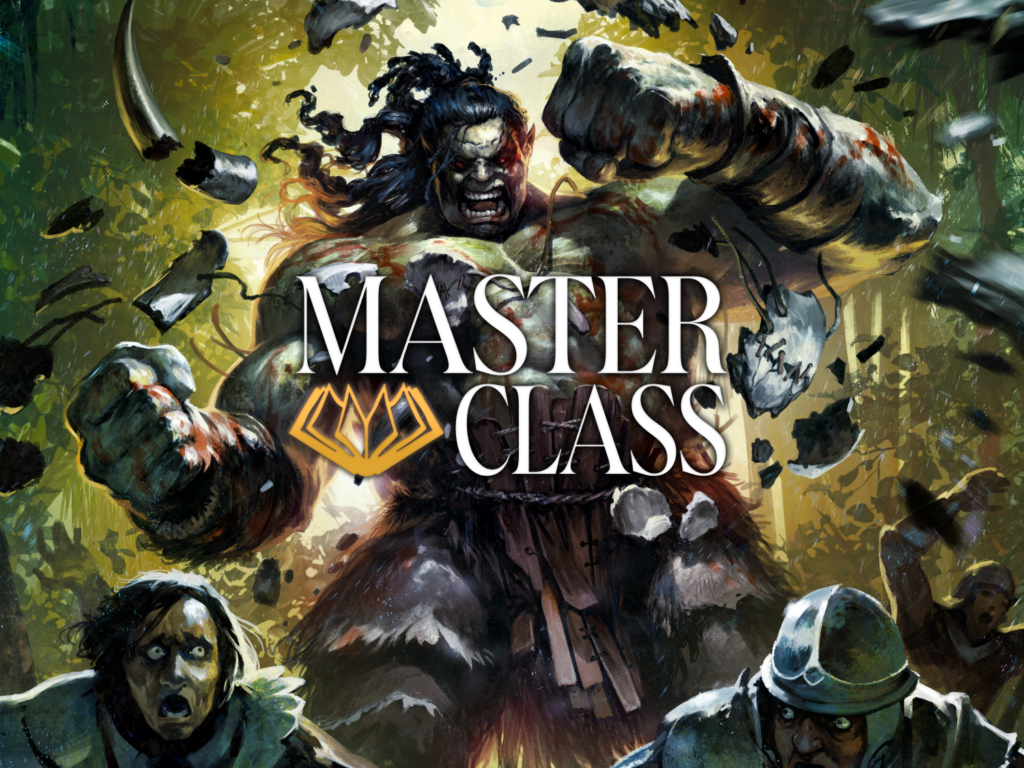
Rhinar, Reckless Rampage is one of Flesh and Blood’s original four heroes who feels like he’s never quite had his time in the spotlight, despite being close on several occasions. With the addition of Super Slam and his recent Armory Deck, Rhinar hasn’t seen widespread adoption, but has seen some respectable results with two copies of Rhinar, Reckless Rampage finishing in the top 16 of Calling: Valencia. However, these new cards along with the recent Banned and Restricted Announcement bringing some of the previous format all-stars down a notch, makes me believe that Rhinar actually might just have what it takes to be a strong meta deck in the upcoming Road to Nationals season. The decklist that will be discussed in this article is a collaborative effort between myself and Elly Bird.
Kayo Exists – Why Rhinar?
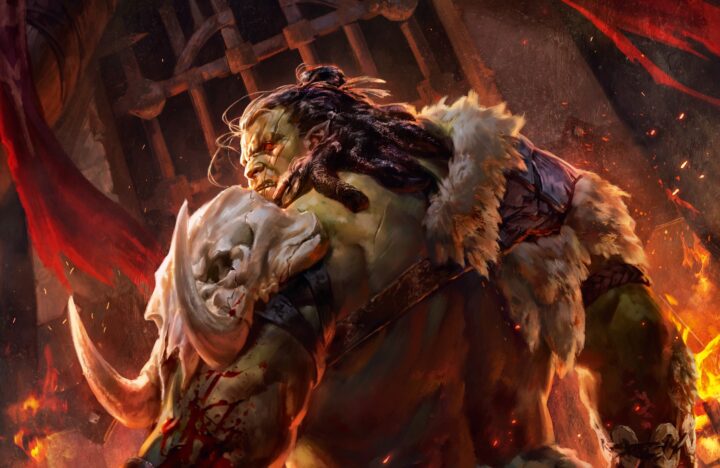
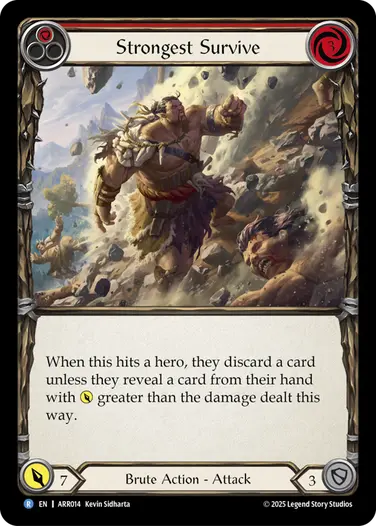
With Kayo, Armed and Dangerous being quite popular and seeing widespread play, you might ask the logical question, why play Rhinar? While Kayo certainly has Rhinar beat in the category of access to blue 6-powers and raw damage output on an average turn cycle, Rhinar can make that up with the ability to defend and play a slower game until he finds his own extremely explosive hands. While Kayo is often priced into playing lots of copies of powerful offensive cards that don’t defend like Reckless Stampede, Wild Ride, Pulping, and Bare Fangs, Rhinar instead can choose to play a very high 3-defense density. Additionally, because Rhinar naturally already has non-6-powers in his deck and doesn’t rely so heavily on draw / discard effects, he can even play defense reactions to further increase his ability to pivot to a midrange role. Combine these defensive tools with powerful disruptive tools like Send Packing, Strongest Survive, and Splatter Skull, and Rhinar is very comfortable playing a slow waiting game until he finds his moment to put the pressure on.
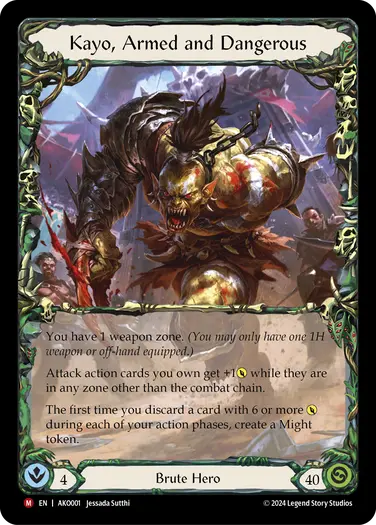
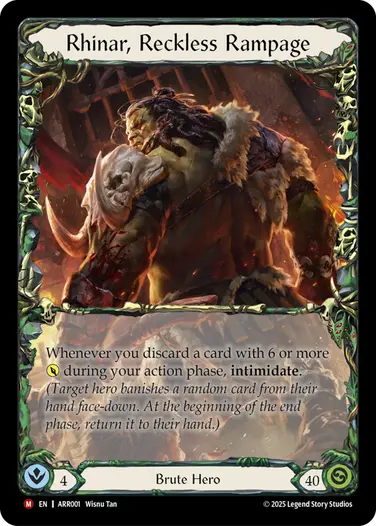
Another strength that Rhinar has compared to Kayo, is he excels against decks that want to defend, as intimidate naturally makes it difficult for opponents to defend where and when they want to. Additionally, since he has access to two claws along with intimidate, it means that while he might struggle more to enable his claws than Kayo, when he does enable them, it is far scarier. Bloodrush Bellow swinging two claws and then ending on a brute attack can easily push 18-20 damage along with an intimidate, and in fact, Rhinar can deal even more damage than this should he decide to commit Savage Sash and get two attack actions in the mix.

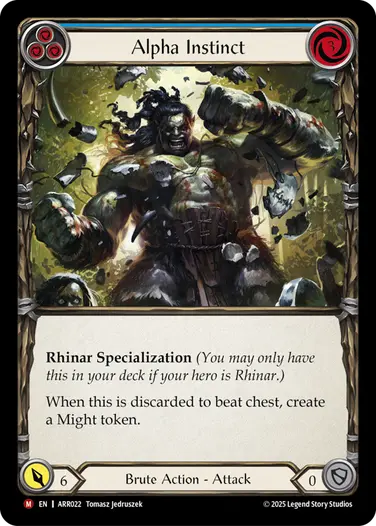
Anyone who has been on the receiving end of one of Rhinar’s Bloodrush Bellows knows just how powerful they can be. However, the problem Rhinar has always faced has been what he does on the non-Bloodrush turns, Over the past year, Rhinar has gotten several tools to help answer this problem, including good disruptive attacks like Splatter Skull and Strongest Survive that work against the whole cast of heroes, along with a functional second copy of Swing Big in the form of Show of Strength. These cards help him play efficient or disruptive two card hands while buying time for his power turns. With the Armory Deck, he also has access to another blue 6-power attack in Alpha Instinct, which helps make running draw / discard effects like Tear Limb from Limb and Wild Ride more consistent than ever. Additionally, Bare Destruction along with Echo Casque and Savage Sash allows Rhinar to have another turn that offers similar output to Bloodrush Bellow, further increasing his consistency.
Power Turns
As previously mentioned, Rhinar is primarily a deck looking to play a slow game until he finds his power turns. This section will discuss what to look for in those powerful turns and how to set them up.
Bloodrush Bellow is Rhinar’s most obvious power card and leads to at least one intimidate and very explosive damage output. Our goal for the average Bloodrush Bellow turn is to be able to swing Mandible Claw twice and end on a Brute attack action, ideally red. This means that on a four card hand, assuming we pitch a blue after we discard, we can swing claw twice and end on an attack, so long as we draw 4 pitch and a 2-cost attack, or 5 pitch and a 3-cost attack. By extension, this means that hands that have a blue, Bloodrush Bellow, and two red 2-cost attacks, or a blue 6-power and a red 2-cost are quite likely to allow for this play pattern. Hands with yellow 6-powers can still work, but are less consistent since they require us to draw a second resource card as well as a threat. If our hand texture is not likely to lead to a good Bloodrush Bellow, perhaps because we have multiple non 6-powers, or too many yellows, we can instead look to arsenal Bloodrush Bellow and wait for a hand that plays it better. Five card hands are far more likely to play Bloodrush Bellow with at least 2 claw swings and an attack action, and can even defend with a card if needed to clear a whiff.
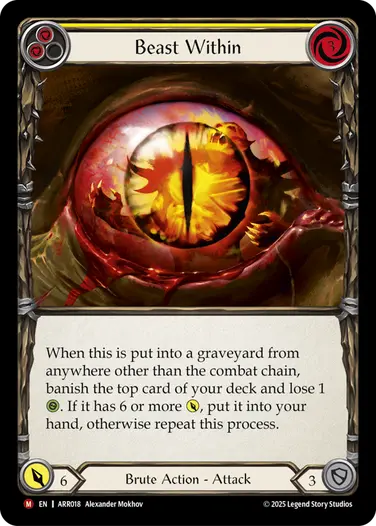
One card that does change the calculus on Bloodrush Bellow quite a lot is Beast Within, due to its ability to functionally draw another card when we discard it at the cost of a bit of life. Playing three card hands, pitching a blue to play Bloodrush Bellow, discarding Beast Within is quite strong and basically always worth doing if we draw it. If Bloodrush Bellow is in arsenal we can also defend with two cards and lean towards this play pattern. In this scenario defending with multiple cards to guarantee the Beast Within discard is generally higher value but also higher variance, where as holding more cards is more consistent.
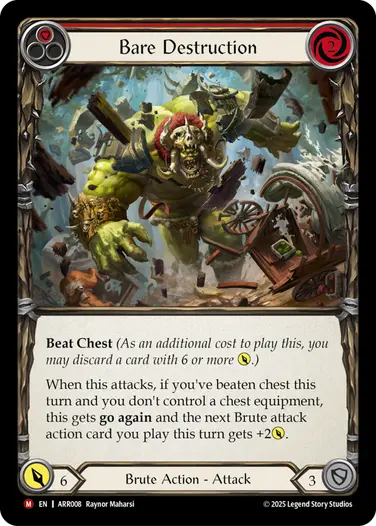
Another power turn we have access to is to use Savage Sash and Echo Casque to play Bare Destruction for 1 resource and spend a resource to draw a card. From here we can look to follow up with 1-2 claw swings and a Brute attack action card so that we can get the +2 power from Bare Destruction. Bare Destruction turns are generally best when we have at least 1 blue and/or a 2-cost guaranteed, meaning it is most reliable on five card hands, although four card hands can also work. Once again, Beast Within makes these turns much more powerful and because Beat Chest is not a random discard, we can do this reliably.
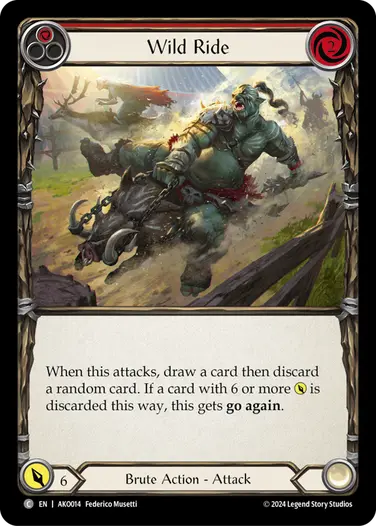
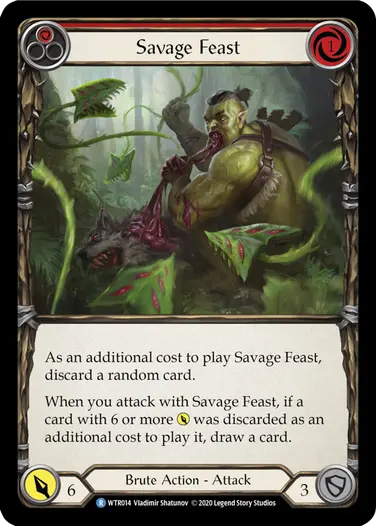
Wild Ride is a card that is almost exclusively played on four card hands with a blue and two 6-powers, or even more ideally on a five card hand with a blue and three 6-powers to increase the odds of getting go again. Additionally, large hands make it easier to claw twice into a follow up attack, although Wild Ride with one claw swing and a 2-cost attack off two blues is also very strong. Savage Feast can also play into these same play patterns but requires us to have an Agility or a Goldkiss Rum to give it go again. Rolling Scabskin Leathers for Savage Feast is also doable and can be quite worth it but of course comes with a significant risk of rolling a 1.
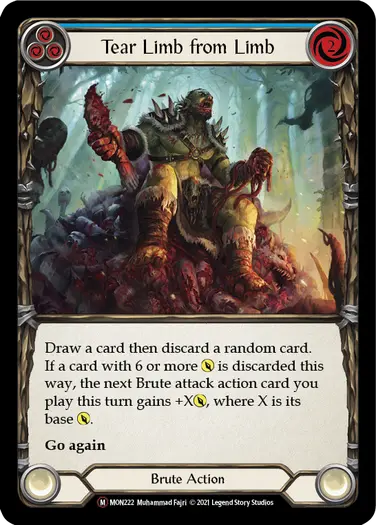
In a similar vein to Wild Ride, we have Tear Limb from Limb which often functions sort of like a blue Wild Ride. Tear Limb from Limb is generally best played when pitching a blue and on four or five card hands. The most common play pattern is to play Tear Limb from Limb, swing Mandible Claw, and then play a 2-cost Brute attack, ideally one with 8-power, for a huge amount of damage. If we don’t manage to find or keep the blue, simply sending a Swing Big, pitching a red for a 4-card-16 with intimidate is still very solid.
In-Between Turns
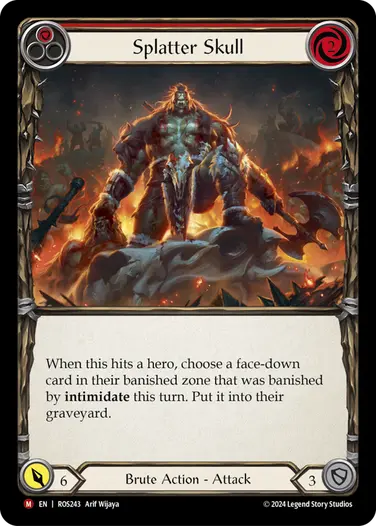
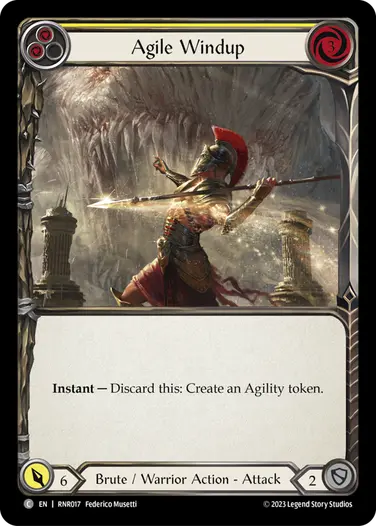
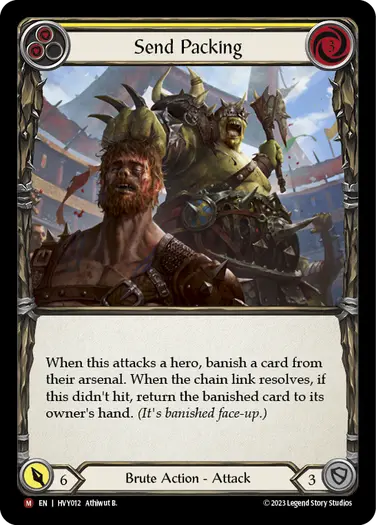
Now that we’ve established what the turns we are hoping to find look like, we need to discuss what to do on the rest of our turns. A lot of the time the answer is simple – we defend. Rhinar gets to play quite a high density of 3-defense cards and can comfortably sideboard in defense reactions if needed. Defending is important because it helps buy us time to find our more powerful hands and helps ensure we have the life total to take damage and keep our hands when we do find them. Outside of defending, Rhinar looks to play strong two card plays while putting powerful cards into arsenal to set him up for success later. Our deck is packed full of disruption like Command and Conquer, Send Packing, and Strongest Survive to help us force the opponent to play a small game with us while we set up to find a power turn. Splatter Skull also plays very nicely with this plan and pairs particularly well with Agile Windup, which can be discarded after damage is dealt and in response to the hit trigger to force our opponent to essentially randomly discard a card, while we get an Agility, should they choose not to defend. Splatter Skull also can be used to in spots where we want to send an attack and arsenal a card as our opponent doesn’t know whether they need to play around the Agile Windup or not!
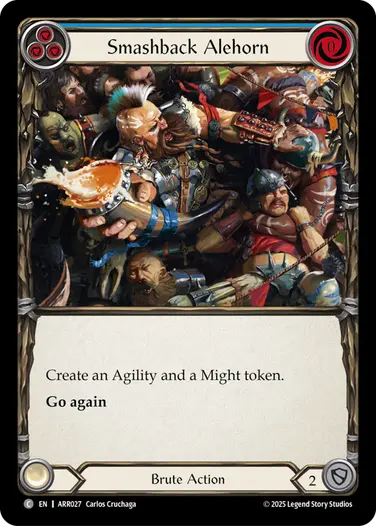
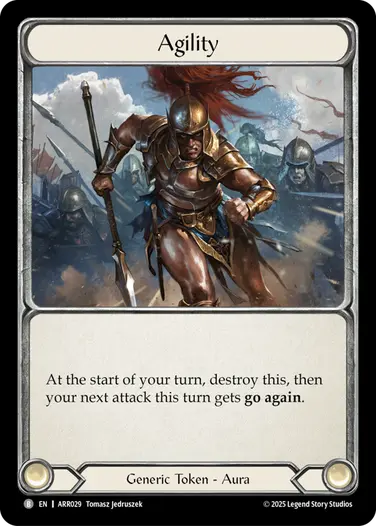
Finding opportunities to play Smashback Alehorn or discard Sea Legs to get a Goldkiss Rum are also great ways to set up on these in-between turns in order to do something powerful on our subsequent turn. Goldkiss Rum and Agility are generally at their best when we get to arsenal a Bloodrush Bellow or Savage Feast. In spots where it is less clear if we can make use of the Agility on our follow up turn, I often prefer to defend rather than resolve Smashback Alehorn.

The Arsenal
As Rhinar often has a bit of an off-turn, on-turn play pattern, establishing good arsenals that help enable your strong turns later is essential. Generally, cards that lead to power turns are our most premium arsenal targets, like Bloodrush Bellow, Wild Ride, and Bare Destruction. After our power cards, strong reds are great to arsenal, especially ones that cost 2 like Swing Big and Show of Strength, as they help ensure we have a premium threat ready when we draw into our Bloodrush Bellow or Tear Limb from Limb. Savage Feast is also quite a strong arsenal so long as we have access to Agility or Goldkiss Rum on the following turn. After these cards are disruptive attacks like Send Packing or Strongest Survive which continue to help us play in-between turns while finding a stronger arsenal.
I generally avoid putting blue 5-powers in arsenal, outside of Run Roughshod which can be high reward but also difficult to resolve. 3-cost 6-powers like Beast Within are better blocked with than put into arsenal, but sometimes due to random draws you wind up in situations where you can only choose to arsenal the card or not use it, and I would basically always arsenal a 3-for-6 over wasting an entire card. While it’s not a premium threat, putting it in arsenal essentially lets you play a 1-card-6 on a future turn compared to if you didn’t arsenal it, which is nothing to scoff at.
Equipment
As with all heroes in Flesh and Blood, weapons and equipment play a massive role in defining the hero, and Rhinar is no exception to this, as he boasts a very powerful set of equipment flush with not only defense value but also useful effects. This section will discuss how to maximize each of these equipment pieces.
Mandible Claw
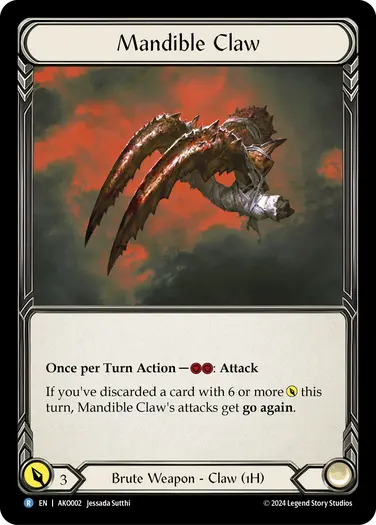
Mandible Claw as a 2-for-3 go again weapon is incredibly efficient but does require us to discard a 6-power to enable. The easiest way to do this is with Bloodrush Below, however, cards like Agile Windup, Savage Feast with an Agility or Goldkiss Rum, Sand Sketched Plan, Wild Ride, Tear Limb from Limb, and Bare Destruction can all enable Mandible Claw. We can also occasionally use claw in conjunction with a 2-cost attack, an Agility, and a Vigor, to enable a 2-cost attack into a claw swing.
Scowling Flesh Bag
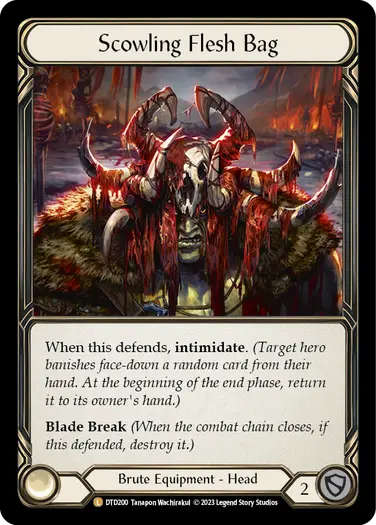
Since being printed in Dusk till Dawn, Scowling Flesh Bag has been the primary headpiece of choice for Brutes and for good reason. 2-defense and intimidate offers incredibly powerful protection. In Rhinar, this equipment is very good, in particular against go-wide aggressive decks, as the intimidate can be very effective at disrupting your opponent’s powerful turns and even set you up to mess with them on the following turn with arsenal disruption like Send Packing or Command and Conquer. Understanding how Scowling Flesh Bag interacts with different aggressive decks is key to getting maximum value out of it. For example, against Oscilio, saving it for their Lightning Greaves and Gone in a Flash turn is a great way to lower his offensive output. Against Brutes, using it on a Bloodrush Bellow turn, or when they have go again and two cards is extremely powerful. And against Cindra, shutting down Mask of Momentum on the third chain link with Scowling Flesh Bag to intimidate their last card is a great way to only have to defend with a single attack for the turn and buy space for your power turn.
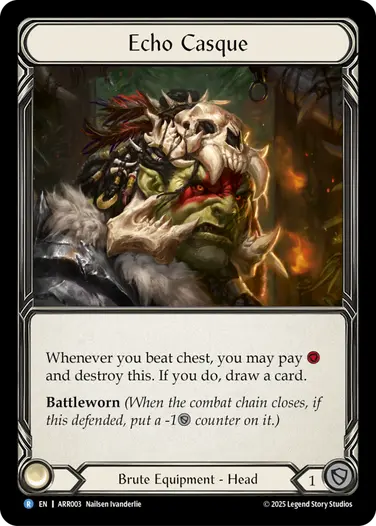
Echo Casque
With the addition of Bare Destruction and Echo Casque, Rhinar now has a great alternative headpiece to Scowling Flesh Bag that trades defensive tools for offensive output. Echo Casque shines in matchups where we need to be the aggressor, and really helps Rhinar do something he previously struggled to do – apply consistent pressure. Echo Casque should always be used in conjunction with Bare Destruction (and usually with Savage Sash) to make it into essentially a 2-card-8 with go again that also intimidates and enables Mandible Claw. These turns frequently produce output similar to Bloodrush Bellow and get even more potent if you can discard Beast Within to Beat Chest. I’m generally willing to defend with Casque if I get decent value early in the game so it’s ready when I need it.
Savage Sash
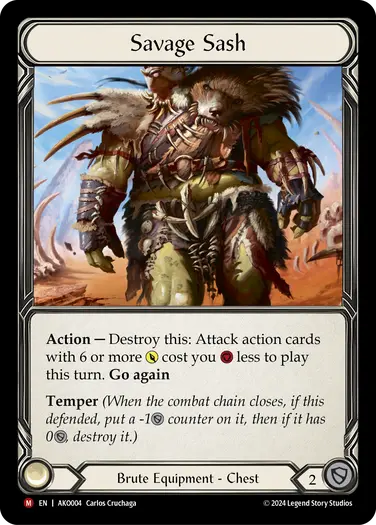
Savage Sash generally defends 2 and can give us 1-2 resources to fuel a powerful Bare Destruction or Bloodrush Below turn, which is a lot of value to get out of a single piece of equipment. While this is frequently used in combination with Echo Casque, don’t be afraid to use it earlier if you really need to, especially on a Bloodrush Bellow turn. Previously, Rhinar decks often played Fyendal’s Spring Tunic for slower matchups, but because Bare Destruction requires an empty chest piece, and Savage Sash is so good at enabling Bare Destruction, we now exclusively run Savage Sash in the deck. Savage Sash should generally be the first 2-defense equipment we defend with so that we have the option to use its ability freely when needed. I almost always try to use Savage Sash for the cost discount rather than the last 1 defense, but don’t be afraid to defend 1 if you really have to and have no other equipment that can do the job.
One notable and slightly unintuitive thing about Savage Sash is that when under the effect of Bloodrush Bellow our 5-power attacks that get buffed to 7 will still receive the discount! This means cards like Run Roughshod and blue Strongest Survive will cost 1 resource less if we Savage Sash on our Bloodrush Bellow turn.
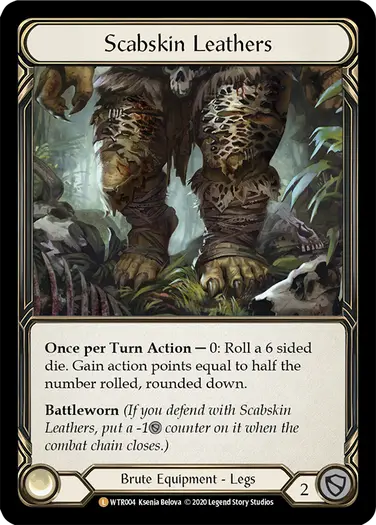
Scabskin Leathers
Scabskin Leathers are primarily used for their amazing armor value, but of course can be rolled for additional action points as well. Scabskin Leathers are generally the second piece of 2-defense equipment we defend with after Savage Sash. These are an important part of helping Rhinar convert hands in key game states, however, choosing when it’s correct or incorrect to roll is quite challenging. As a rule of thumb, you should generally prioritize defending with cards instead of keeping them to roll Scabskin Leathers, and you should only roll Scabskin Leathers when it increases your damage output by roughly 50% or greater. An additional wrinkle is that if we are very behind and rolling Scabskin Leathers can allow us to win the game, we should lean towards rolling. Conversely, if we are ahead and winning even without rolling Scabskin Leathers, we should avoid it even if it is efficient to do so. Be careful though, as correctly identifying if you are winning in a given game state can also be quite challenging to do effectively.
For those wanting to get a bit more into the weeds on Scabskin Leathers, you can calculate the average value of rolling as:
1/3 A + 1/2 B + 1/6 C
Where A is your damage output if you roll 1 action point, B is your damage output if you roll 2 action points, and C is your damage output if you roll 3 action points. Generally, you should only look to roll Scabskin Leathers when your average value from rolling is greater than the value of your play if you don’t roll. However, keep in mind that our goal is actually to maximize win percentage which is often but not always the same as maximizing value. I would say the best way to do this is to avoid needlessly risky Scabskin Leathers rolls when you are already in a winning position.
In many cases, rolling 2 action points and 3 action points result in the same outcome. in this case B and C are equal and the equation can be simplified to:
1/3 A + 1/2 B
Where again A is 1 action point and B is 2 action points. Under these circumstances, we can also solve to find what the break-even for rolling Scabskin Leathers is. I won’t get into the calculations in this article, but it works out to be the case that when B is more than 33% larger than A it is positive expected value to roll Scabskin Leathers. In practice, I tend to only roll Scabskin Leathers when it’s at least a 50% increase in value, as I want to be gaining a decent amount of value to take on the risk of potentially rolling a 1, but everyone has varying levels of risk aversion.
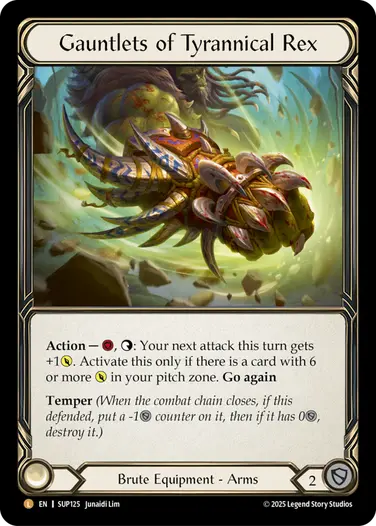
Gauntlets of Tyrannical Rex
Gauntlets are primarily Temper 2 with a bit of added upside. In my experience I get to activate them roughly 2-3 times per game, which feels like a bit more than Apex Bonebreaker on average. However, if you have strong feelings about Apex Bonebreaker or own one and not the other, the two equipment are interchangeable enough. When playing with Gauntlets it’s important to find opportunities to pitch 6-powers slightly earlier so you have the option to activate them later in the turn. You also generally want to defend with Gauntlets after everything else (except for the last block on Savage Sash), as they can continue to get value over the course of the game.
Sideboarding
Our Rhinar deck consists of a 51-card core with the following cards making up the inventory:
- 3x Bare Destruction
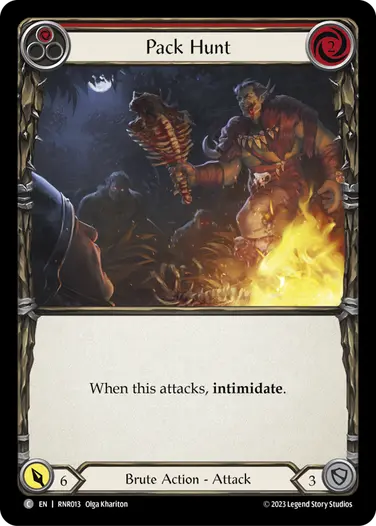
- 3x Pack Hunt
- 3x Wild Ride
- 3x Strongest Survive (red)
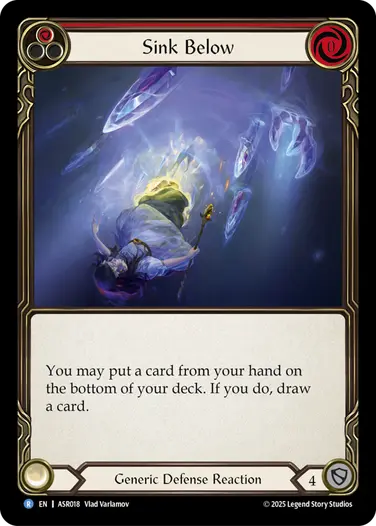
- 3x Sink Below
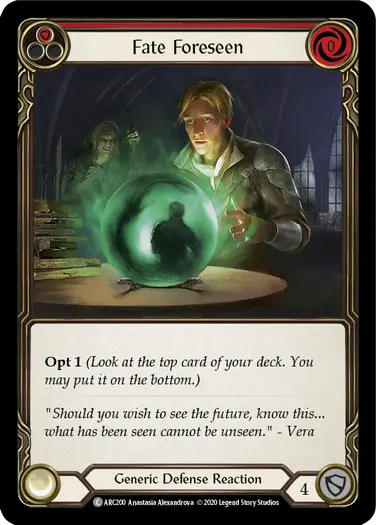
- 3x Fate Foreseen
- 2x Tear Limb from Limb
- Skullhorn and Nullrune Gloves (for arcane matchups)
The deck has three distinct modes it can sideboard between: Full Aggro, Defensive Disruption, and Aggro Race.
Full Aggro
With his new card pool Rhinar is finally quite proficient at being the aggressor. In this sideboard package we bring in 3 Bare Destruction, 3 Pack Hunt, 3 Wild Ride, and board out 2 blues for Tear Limb from Limb (usually Vigorous Smashup, Strongest Survive, or Smashback Alehorn, depending on the matchup). Our equipment of choice for this setup are Echo Casque, Savage Sash, Gauntlets of Tyrannical Rex, and Scabskin Leathers. This sideboard plan maximizes go again and Mandible Claws, even leaning into draw / discard effects like Wild Ride and Tear Limb from Limb. This setup is best when we can do minimal amounts of defending and really focus on pressuring our opponent’s life total. Matchups this sideboard plan work well against include Gravy Bones, Earth heroes, Jarl, Kassai, and Arakni, Huntsman.
Defensive Disruption
Other times we want to take a slower, longer game and win off the back of one to two big plays, which is exactly where this sideboard plan shines. For this plan we bring in Sink Below, Fate Foreseen, and Strongest Survive, which maximizes both our defensive and disruptive options. As far as equipment goes we play Scowling Flesh Bag, Savage Sash, Gauntlets of Tyrannical Rex, and Scabskin Leathers. This setup is at its best against aggressive leaning decks where defending is beneficial and we want to play a longer game. Examples include Dorinthea, Dash I/O, Boltyn, and Katsu.
Aggro Race
Against certain aggressive decks playing too passively can often put you in a bit of a rut, so instead we look to play an aggressive package with disruption to keep them on the back foot and shorten the length of the game. In these matchups we play Bare Destruction, Strongest Survive, Wild Ride, and Tear Limb from Limb to give us lots of aggressive tools to push for a short game while still maximizing our disruption. On the equipment side of things we want to run Scowling Flesh Bag, Savage Sash, Gauntlets of Tyrannical Rex, and Scabskin Leathers. Scowling Flesh Bag is generally a great extra layer of defense against these decks and can buy us the space we need to resolve our own powerful turns. Examples of decks where this sideboard plan shine include Oscilio, Cindra, and Kayo.
Playing against Rhinar
Rhinar tends to attack opponents on a variety of axes and often decks will care about some of these more than others depending on what their own gameplan is. The main way Rhinar attacks his opponents is through the following three ways: intimidating cards the opponent might want to block with, sending disruption while playing solid defense, and having powerful 18+ damage turns with evasion thanks to intimidate.
Decks that actively want to defend tend to struggle more with intimidate, especially if they are particular about the cards they want to defend with. Verdance is a great example of this. These decks should look towards putting flexible cards into arsenal that can help them convert (like Enlightened Strike), and aim to defend earlier in the combat chain so as to not get stranded with dead cards should Rhinar intimidate you a second time, especially if you have multiple defense reactions in hand. Save equipment defense and/or defense reactions in arsenal for disruptive on-hits when needed.
Aggressive decks tend to care a lot more about the defensive and disruptive parts of Rhinar’s kit. Putting defense reactions into arsenal or bringing in additional equipment defense (if possible) can help deal with these disruptive attacks. Just make sure not to overdo it with too many defense reactions as getting cards stranded due to intimidate can be quite punishing. Additionally, like many disruptive decks, Rhinar isn’t always able to convert, especially when he sideboards in more defense reactions and disruption instead of go again sources like Wild Ride or Tear Limb from Limb. Because of this, it’s generally best to defend his disruption if you have a reasonable ability to do so, and play towards large hands. Sending small two to three card hands can often simply help Rhinar convert some of his clunkier hands and walks into his desired play pattern of strong two card hands.
Finally, Rhinar’s most powerful means of attack are his power turns that also intimidate cards and reduce the opponent’s ability to defend. Putting defense reactions into arsenal and saving equipment defense can help stave off some of these turns and reduce the damage leaked. However, the best way to combat this aspect of Rhinar’s kit is by being proactive. One of Rhinar’s greatest strengths is his ability to push tough-to-defend damage, and decks that are overly defensive can really struggle to deal with that gameplan. If your deck is at all able to sideboard more assertively so that it’s able to pressure his life total and avoid giving him unlimited time to find his power turns, that is generally your best path to success.
Rhinar’s Place in the meta
It’s difficult to say exactly where Rhinar will land as we just had a substantial Banned and Restricted Announcement, as well as Kano hitting Living Legend status, meaning there will likely be a significant format shakeup. When trying to predict the direction the metagame is likely to shift, I actually think things look quite favorable for Rhinar. In this section we’ll discuss what I think some of the impacts of the recent shakeups might be, and how Rhinar fits into that.
With the loss of Brand with Cinderclaw and Wrath of Retribution, I expect Cindra to still be present but to get meaningfully weaker and potentially require a substantial rework in deckbuilding. Earth heroes like Florian and Verdance will likely lose an even more substantial amount of power with the banning of Rootbound Carapace and will likely drop quite steeply in representation. All of these are big wins for Rhinar, as I felt his Cindra matchup was playable but a bit coin flippy, and the defense of the Earth heroes, especially Florian, could be tough to overcome. Now I think Rhinar is both less likely to encounter these heroes and should be more easily able to deal with them if he does.
Gravy Bones also received a ban in Chart the High Seas, but I think will be able to adapt with minimal changes. However, he has lost some favorable matchups in the Earth heroes, and may fall victim to some decks with recent strong performances like recent Calling: Seattle winner Kassai and Calling: Valencia double Top 8 appearance Oscilio. Of these matchups, Gravy Bones is playable so long as we can consistently enable claws to clear allies while finding our big intimidate turns to push for lethal. Kassai is quite a close matchup for Rhinar, as she generally likes to do a fair bit of defending and intimidate can make that very difficult. In my experience, Oscilio struggles probably the most of these three heroes into Rhinar, as his combination of heavy damage and disruption can make it quite hard for Oscilio to find his own combo turn in time.
The other main hero affected by the Banned and Restricted Announcement that has not been mentioned is Arakni, Marionette. Pre-ban I found this matchup to be surprisingly quite solid for Rhinar. Marionette is in a weird position where they don’t really want to do a whole lot of defending, but occasionally want to trim down on one or two clunky cards when their hands don’t quite line up, which can become very problematic in the face of intimidate. Additionally, because Rhinar has access to so much disruption, he can enact a fairly similar gameplan into Marionette of pushing for a lot of damage while also taking a card from his opponent. I imagine with the loss of blue and yellow Orb-Weaver Spinneret this matchup can only improve.
Road to Nationals season marks an exciting shift in the metagame, and I’m looking forward to exploring it further and seeing how everything shakes out. When looking towards your own tournaments I would highly encourage you to give Rhinar a consideration, as he has gained a ton of power in the last few sets.