Legend Story Studios developer Karol lifts the curtain of the Dev Room so we can take a peek behind the scenes. Learn about the work that went into designing, testing, and evolving the iconic cards you know and love today. Sometimes all a card needs to be great is a Dev Touch!
This week’s article might be the most personal one yet, because it represents the full circle of my Flesh and Blood development and design journey. More than five years ago, around the release of Arcane Rising, I began experimenting with the classes available at the time. When I picked up Rhinar and played a few games, I never looked back. Rhinar was the first hero I truly fell in love with. There was something deeply satisfying about intimidating my opponent and hearing them mutter “of COURSE you hit the only card I wanted to block with!”. His gameplay loop hooked me instantly: the controlled, incremental value turns, trading efficiently, and then – out of nowhere – exploding into a massive combo turn.
Despite loving calculated gameplay, I found the unknown information, random discards, and unpredictable intimidates made the Brute class uniquely exciting. Every turn felt like a puzzle where risk, probability, and instinct all mattered, creating a style of play that was both volatile and incredibly rewarding.
Fast forward five years… When I got the shoulder tap to design Armory Deck: Rhinar, I knew exactly where I wanted to take it: Beat Chest. Rhinar is the Alpha Brute. When he beats his chest, everyone in the arena knows they’re in for the beating of a lifetime. That feral energy became the heartbeat of the deck.
As much as I love the draw / discard randomness the Brute community often gravitates toward, I wanted this deck to appeal to two main audiences:
- New players picking up Brute for the first time
- Seasoned Brute enjoyers looking for new toys
Beat Chest hits the sweet spot for both groups. Despite its wild theme, the mechanic is surprisingly controlled; you choose which card to discard – none of that draw and pray chaos, and once you’ve beaten your chest, every Beat Chest trigger is satisfied for the rest of the turn. It smooths out variance for new players while rewarding the veterans who enjoy sequencing multiple triggers with deliberate setup and tight resource management.
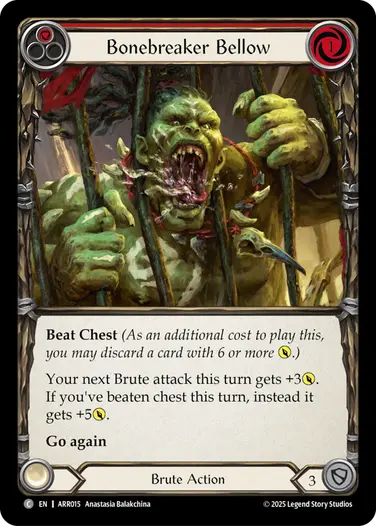
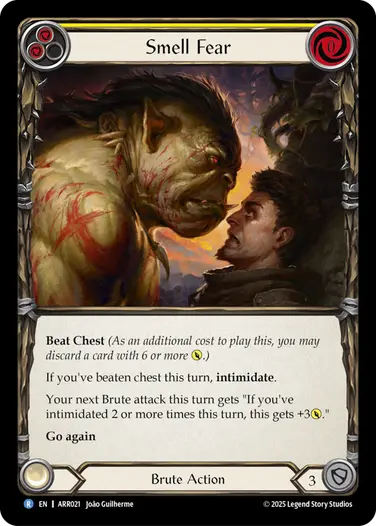
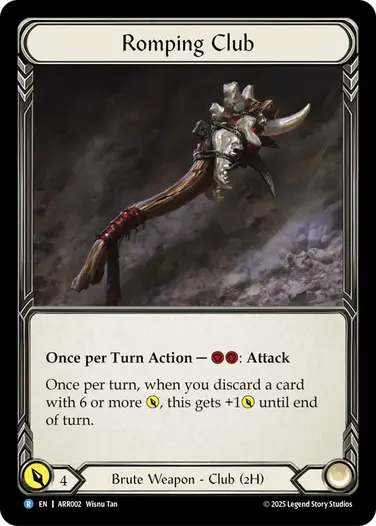
As a starting point, I revisited the existing pool of Beat Chest cards. Bonebreaker Bellow already looked promising and paired nicely with Romping Club for consistent value turns. It was a clear inspiration and follow up for Smell Fear, which continued the turn-long pump pattern for club-based gameplay. But when it came time to design Majestics, I knew we needed something bigger…
Raw Power Swing
Raw Power Swing was one of the earliest Beat Chest cards I sketched out. I wanted a Majestic payoff – a moment that felt like channeling pure, unrestrained strength after all the setup. Heavy Hitters only introduced Commons and Rares for the mechanic, so the Armory Deck was the perfect opportunity to debut something more impactful. My first draft looked like this:
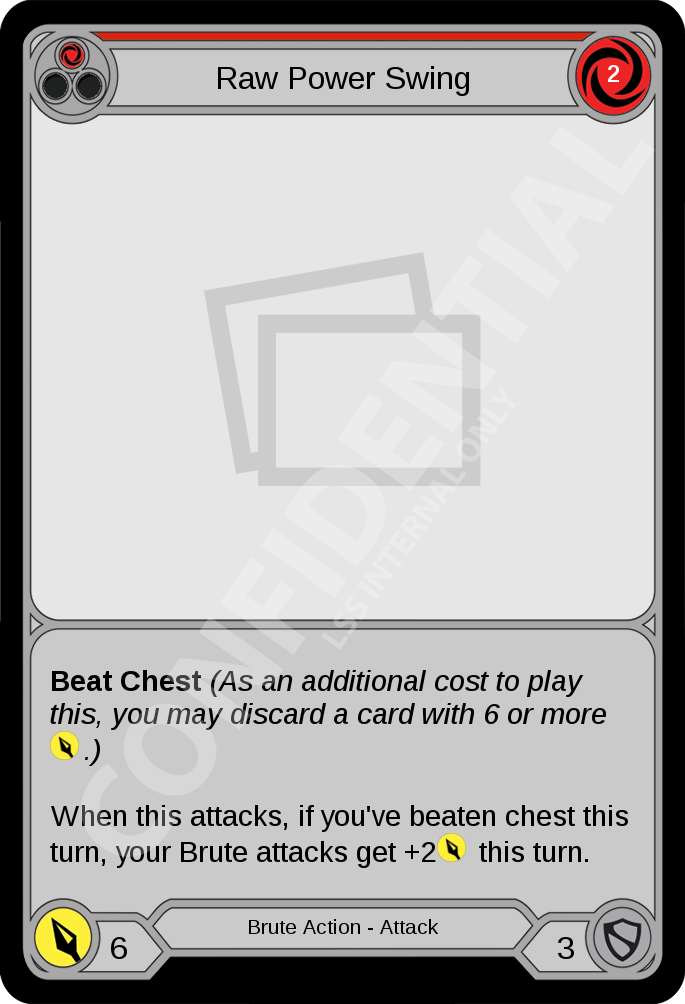
Clean. Simple. Possibly too simple.
The design intention was a strong payoff, if you could find a way to give it go again. Play patterns like using Agility tokens or equipment like Beaten Trackers enabled it. But there was a risk: nothing on the card itself explicitly stated that requirement. It worked conceptually, but not for a beginner product. It could lead to new players feeling confused or stuck on how the card was actually meant to work.
Another concern was its interaction with Mandible Claws. Turning on a turn-wide +2 into claws felt a little too close to Bloodrush Bellow, and I wanted this Rhinar experience to carve out its own identity. Feral, but not derivative.
The “Bare” Inspiration
During development, some devs step outside to clear their heads when a development problem refuses to budge. I do the same. One day, while thinking through the ideal Beat Chest play patterns, I stepped out for fresh air. Deep in thought, I closed my eyes and physically mimed beating my chest to get into the Brute mindset.
“Would be more effective without that lanyard, buddy,” another dev joked.
I looked down – shirt, jacket, keycard lanyard all bouncing around – and immediately realized how awkward it was to actually beat my chest with all that stuff in the way. And then it hit me.
What if not wearing chest equipment made you stronger?
A moment of flavor turned into a mechanical breakthrough. The chest slot was already the natural centerpiece of Beat Chest, but suddenly removing that equipment became the payoff. That idea not only redefined the key Majestic, but also inspired a new chest equipment that synergized with going “bare.” Together, they created a mini-theme built around unleashing your inner Brute by literally freeing your chest.
This theme also led to the creation of Bare Swing, allowing me to push above the typical rate of Beat Chest attacks like Pound Town and Assault and Battery.
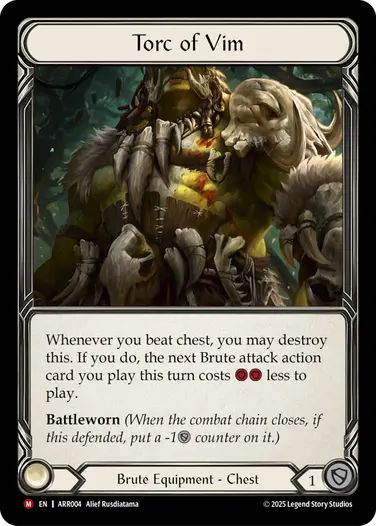
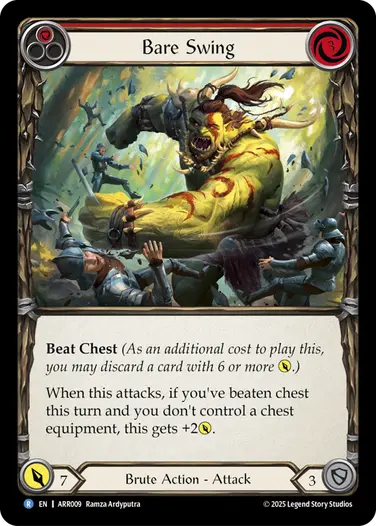
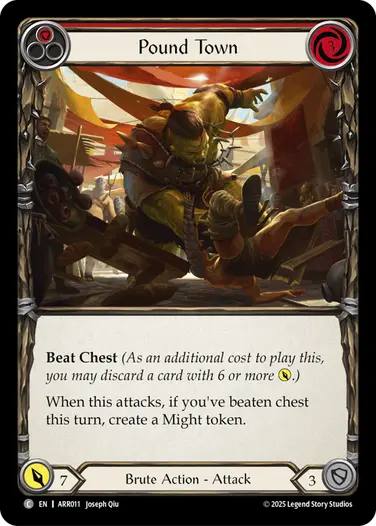
After lots of iteration on stat lines and buff numbers, the wider design team settled on the final version of Bare Destruction – the one you now know.
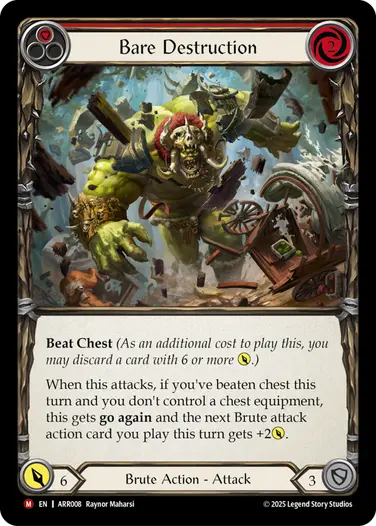
What excites me most about the finished card, beyond its thematic punch, is its flexibility. In the Armory Deck, it synergizes with every piece of equipment and ties the entire Beat Chest suite together, giving new players a clean, cohesive play experience. For long-time Brute players, I hope it sparks some deckbuilding creativity. Not just for Rhinar, but the whole array of available Brutes.
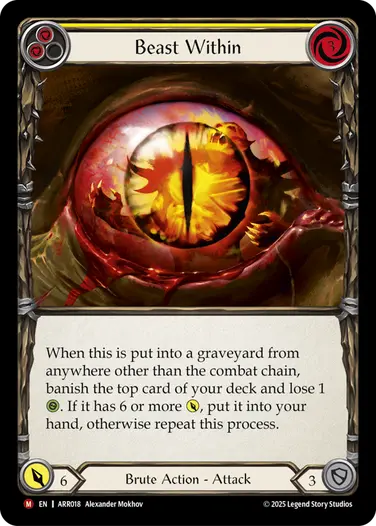
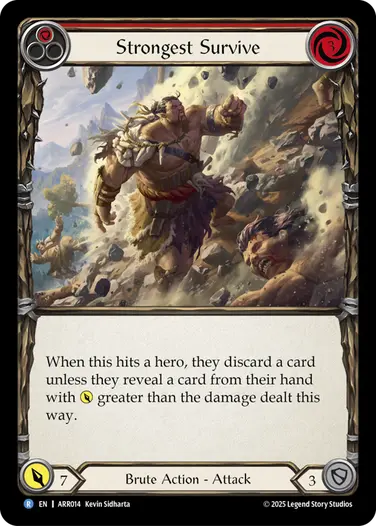
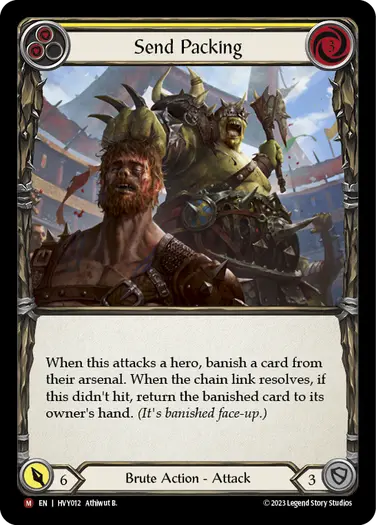
The way Bare Destruction interacts with Beast Within and Sea Legs, giving players full agency over their discard choices, makes me optimistic we’ll see it popping up even outside of Beat Chest-centric decks. Another unique angle is that its buff carries to the next attack action card, making it ideal for disruptive follow-up threats. Whether it’s Strongest Survive, Send Packing, or Splatter Skull – Bare Destruction creates undeniably powerful sequences.
And there you have it, some insight into how Bare Destruction came to life and how it helped shape the wider themes of Armory Deck: Rhinar. It’s a card born from both flavor and function, one designed to help players find their inner Brute. With players like Florin-Cristian Loghin showcasing what the Brute class is capable of on the world stage, I wouldn’t be surprised to see more Brutes smashing their way to top tables in the near future. Maybe you can be the player to leverage the Brute class to earn the next World Championship title.