Legend Story Studios developer Karol lifts the curtain of the Dev Room so we can take a peek behind the scenes. Learn about the work that went into designing, testing, and evolving the iconic cards you know and love today. Sometimes all a card needs to be great is a Dev Touch!

Tales of Aria was the first set Kieran (AKA Mr. Classic) and I ever worked on. To this day, I remember the moment we went from competitive players to game developers, peeking behind the curtain to see how Flesh and Blood is actually made. The first thing I learned? Juggling an entire set’s worth of attack values, costs, and abilities to create a balanced, fun, cohesive environment is far harder than it looks. The second thing? Coming up with original design concepts is even harder. Development is one thing; design is a whole different plane of existence. Still, Kieran and I gave design a go in the early days, yet our paths ended up diverging rather quickly.
I still remember my very first design. It was inspired by Blessing of Deliverance: reveal cards from the top of your deck, then get different effects based on the revealed elements, that kind of thing. It was also over ten lines long and would have taken eons to resolve. I showed it to lead developer Chris Gehring. His feedback was short, sharp, and very Chris:
“It’s too long. Best designs are simple and concise.”
From then on, I kept grinding away, trying again and again to produce something printable. I think I slid about 20 different designs onto Chris’ desk before I finally got a “Hmm… that’s interesting.”
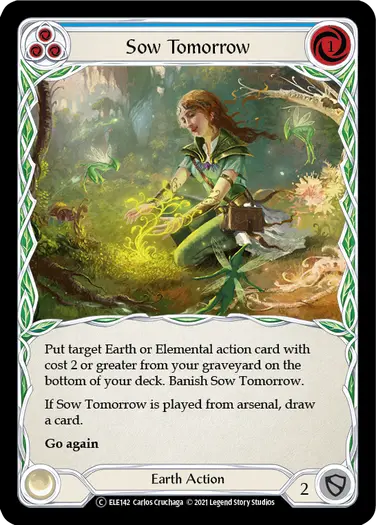
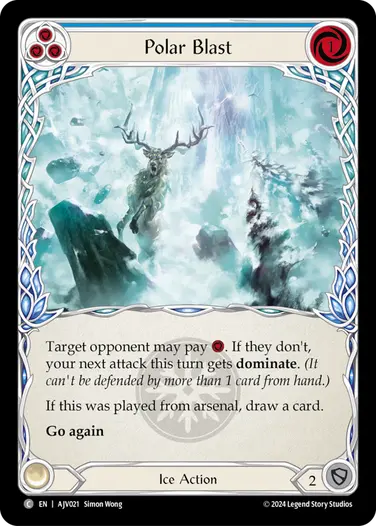
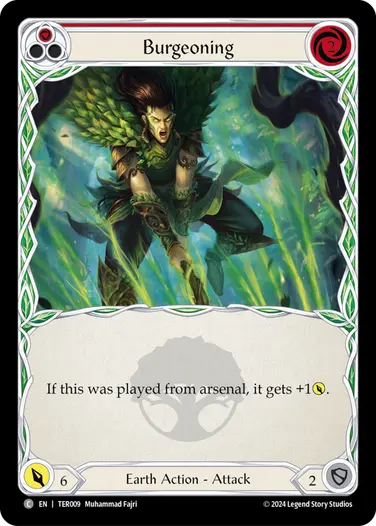
We had an Earth Rare slot that still needed filling. After a few more overly-ambitious ideas, I pitched a simple 3-cost, 7-power attack that created an Embodiment of Earth when played from arsenal. It looked straightforward, except we weren’t even sure yet whether Embodiment of Earth was going to be an Earth token or an Earth Runeblade token. What it did solve, though, was a core issue with the fuse mechanic. Cards we fused with, because of how they work with fuse, often ended up sitting in the arsenal, but most of them didn’t actually justify being arsenal targets. Adding a “when this is played from arsenal” clause created a natural incentive that smoothed the fuse mechanic across the set. That’s how cards like Electrify, Sow Tomorrow, and Polar Blast ended up with that extra line of text. As for my original design, it got simplified even further – the Embodiment of Earth creation became +1 power, the card became a 2-cost 6-power, and it moved from Rare to Common. And thus Burgeoning was born.
Kieran, meanwhile, took a very different approach to design.
For those who don’t know, his favorite card is Enlightened Strike (tied only with Ancestral Empowerment). Ever since Welcome to Rathe, his decklists have almost always included this generic Majestic, and for good reason. Some cards increase a deck’s ceiling (like Bloodrush Bellow launching Brute turns into orbit). But others, like Enlightened Strike, raise a deck’s floor, smoothing out awkward hands. Even top-tier decks can draw an unconvertible grip. A Cindra can whiff a Draconic starter and turn four cards into 3–4 damage. Inconsistency is universal. But add an Enlightened Strike and suddenly the hand has shape again.
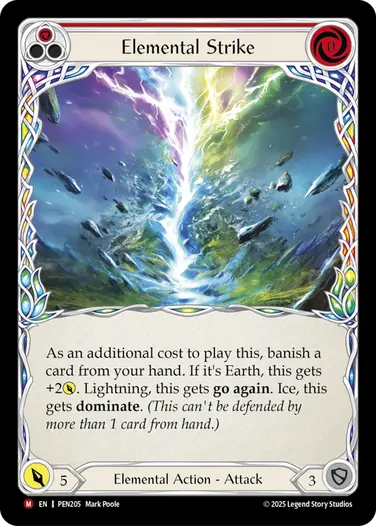
“What if it’s like Enlightened Strike… but for Elements? Let’s call it… Elemental Strike.”
I wasn’t sure if the idea borrowed a little too much shine from the original, but the concept was pretty cool. Kieran’s initial version involved revealing a card from hand as an additional cost, then gaining the corresponding Elemental bonus:
- +2 power for Earth
- dominate for Ice
- go again for Lightning
Then finally tucking the revealed card on the bottom of the deck.
“No.”
Another swift, merciless strike from Chris. And I got the sentiment, the ability was dangerously close to fusing without actually being fuse, which risked confusing players within the same product. But unlike me, who immediately abandoned my first design, Kieran did not budge. He iterated, polished, and championed Elemental Strike repeatedly. The more he tried, the more visibly irritated Chris seemed to become.
Eventually, Tales of Aria went to print. Everfest began. Yet Elemental Strike refused to die. With every new set, whenever a majestic slot needed filling, Kieran submitted Elemental Strike with the persistence of a man convinced destiny was on his side. The idea took on a life of its own. Still, to no avail.
Then, about two years later, a slot needed filling, maybe for Bright Lights, maybe Heavy Hitters. Chris happened to be away. Kieran managed to convince James White himself to add Elemental Strike to the list. It worked. The design actually made it into our internal card database. We were stunned. Chris, upon returning, saw it in the system, jumped into his car, sped to the office, wiped it from the whiteboard, and deleted it from existence. Gone again.
We all thought that was the end of Kieran’s first design, but the legend persisted. Half-joke, half-myth, it kept resurfacing – especially when expansion slots were being discussed, and again during the Elemental set, Rosetta. Early on, the card clashed too heavily with Enlightened Strike, but as time passed, nostalgia for that original generic Majestic grew. And with nostalgia came room for homage.
When Compendium of Rathe was revealed to us – and the idea of creating a card for nearly every existing frame became a real goal – we had to resurrect Elemental Strike. As luck had it, the set was also missing a strong idea for an Elemental-only majestic. When the conversation swung back, Kieran’s long-suffering design suddenly felt perfect. Compendium of Rathe celebrated the history of Rathe and of Flesh and Blood as a whole – what better place for a tribute? After some discussion, Elemental Strike was officially back on the table.
We did need to rework it to match the rest of the Elemental suite.
A major update was changing the revealed card to being banished instead. I believe that one was actually Chris’ idea. It added a neat bit of depth for Earth heroes. Previously, hitting the 4 Earth banish threshold relied mostly on decompose. But Elemental Strike now provided an extra banish, letting Earth heroes hit their decompose timing right out of the gate. As a loyal Florian and Jarl fan, Kieran (and his internal Earth decks) were delighted – maybe a little too delighted, given how often extra copies of the card mysteriously appeared within our internal lists.
Personally, I love the synergies between the Elemental cards in Compendium of Rathe. Elemental Strike and Colors of Aria, for example, read and play beautifully together. I’m glad we finally found the perfect home for Kieran’s idea.
Like fine wine, some things just need time. In the case of Elemental Strike, that “time” was nearly five years. In a way, Chris’ reservations allowed it to be printed at the best possible time. When the card finally lands in players’ hands next month, I’ll already be looking forward to Kieran’s next idea, and to hearing Chris’ blunt, unfiltered reaction. And who knows, if we’re lucky, maybe we’ll even see it printed before the decade is out!