Legend Story Studios developer Karol lifts the curtain of the Dev Room so we can take a peek behind the scenes. Learn about the work that went into designing, testing, and evolving the iconic cards you know and love today. Sometimes all a card needs to be great is a Dev Touch!
As you might guess, Flesh and Blood devs love games. Card games, board games, computer games – you name it, we love them all. Most lunchtimes you can catch us battling to optimize our Wordle guesses, racing to be the fastest in Connections, or clashing over mobile games. Saying we’re competitive is an understatement.
Sometimes, we even invent our own games.
For Wordle, we once ran a “championship league” where each day we’d introduce a custom rule. There were plenty, often with hilarious twists – the winner is the one with the most greys, first person to a five-shot win, or everyone had to start with a specific word. It was a ton of fun, though the competition could get intense.
But one dev stands out when it comes to making up games – Jason Chung. Jason has an innate ability to gamify almost anything, from determining draft seat order to livening up a Monday catch-up.
True or false
One Monday, Jason told us a jaw-dropping story. I can’t remember exactly what it was, but after sharing it, he asked: “Do you think it’s true or false?“
It was completely outrageous and the suspense kept us all on the edge of our seats. But right after we all guessed, it turned out to be false. Jason simply didn’t have an interesting story from the weekend and wanted to mess with us a bit. That sparked a daily ritual we called “True or False”, where Jason would tell an unbelievable story and we’d have to decide if it was real or pure fiction. Some weeks we even tracked results, and soon a metagame emerged – Too unbelievable to be true? Probably true. Too believable? Must be false. Jason, of course, kept us guessing by mixing it up. This game went on for over a year, and in hindsight, seemed to foreshadow the creation of one of Super Slam’s most unique Super Rares:
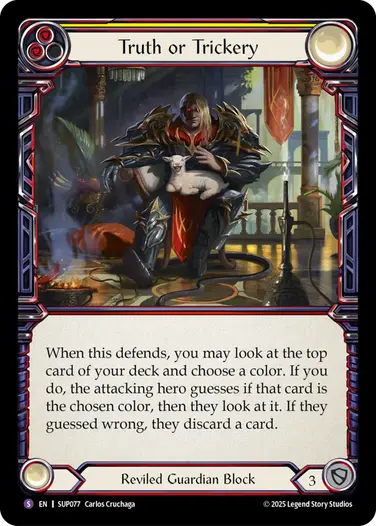
At first, Truth or Trickery was a 4-defense red, worded almost exactly as the final version. Most of its development was shaped by iterations of Lyath’s hero ability. Sometimes Lyath halved defense values of block cards, sometimes not, and each tweak forced adjustments to the card.
The card was a blast to develop. It’s rare that we get to focus so much on the feeling a card evokes and this one delivered a rollercoaster of reactions. Early playtests saw opponents calling for nerfs while Lyath players reveled in its mischievous design.
Soon, a Truth or Trickery metagame formed in the Dev Room. Some argued the guess was purely mathematical – based on deck ratios, always choose blue. Others countered that Lyath could exploit such logic, so maybe it was better to second-guess. We went deep into poker-style mind games. Calum Gittins even leaned into the theme, donning sunglasses and a deadpan poker face during top of the deck reveals.
The more we played, the more entertaining it became. Three Floating perfectly captured the tension the card created. Even outside competitive play, it generated unforgettable moments – pure excitement in just a few lines of text.
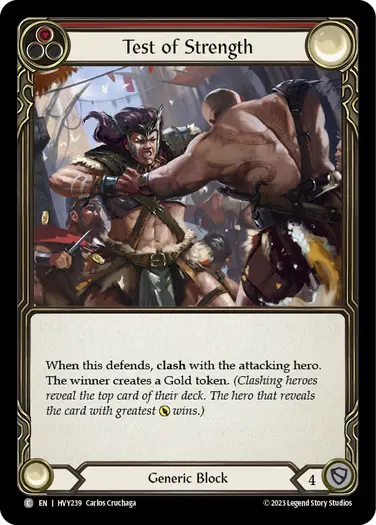
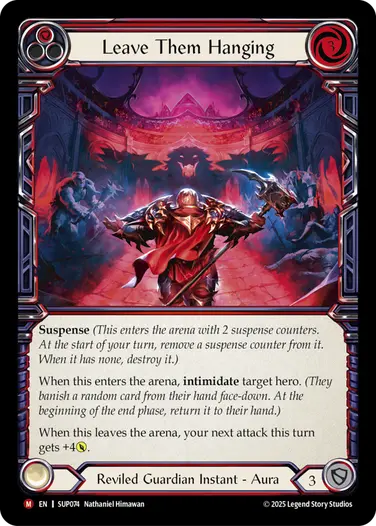
Of course, fun alone isn’t enough. Calum lead the charge in testing whether the card was fair. He noted that unlike similar cards, such as Test of Strength, opponents didn’t gain any compensation when they guessed right. Combined with Lyath’s suite of disruptive tools (Leave them Hanging, on-hit effects), there was concern that players might feel robbed of agency.
We experimented with adding small downsides but found the extra text bogged the design down. Ultimately, the card’s real drawback emerged through deckbuilding tension. Lyath thrives on efficiency, so slotting in a yellow with only pseudo 2-defense created trade-offs and inconsistencies. That tension became the balancing factor.
Once it settled as a yellow 3 defense (2 in Lyath), Truth or Trickery hit the sweet spot. Even its own pitch value subtly influenced deck ratios, adding to the mind games.
One of the things I liked to do with Truth or Trickery was to not even look at the card and call the pitch while looking away. We even had a slight dive down a rules rabbit hole of whether we could force the active player to actually look at the card. Honestly, for someone who couldn’t hide my reactions, this method worked relatively well.
To this day, the Dev Room still erupts with laughter when Lyath testing brings Truth or Trickery to the table. Just like Jason’s “True or False” game, it continues to spark new theories, wild logic chains, and bragging rights over hit rates.
When Allen Lau and Shing Tsang joined the development team, it was only natural for them to familiarize themselves with heroes they hadn’t seen before. Lyath was one of them. Shing’s first impression was unforgettable – he won every single Truth or Trickery reveal against Allen, much to the room’s amusement.
In the end, Truth or Trickery isn’t just a clever design – it’s a snapshot of our Dev Room itself. Jason’s daily “True or False” game showed how a simple idea can ignite laughter, rivalry, and endless theorizing, and that same spirit found its way into the card. Its tension, its bluffing, and its delight in surprising people all reflect the way we approach game-making: playful, competitive, and always chasing those memorable moments that bring people together.