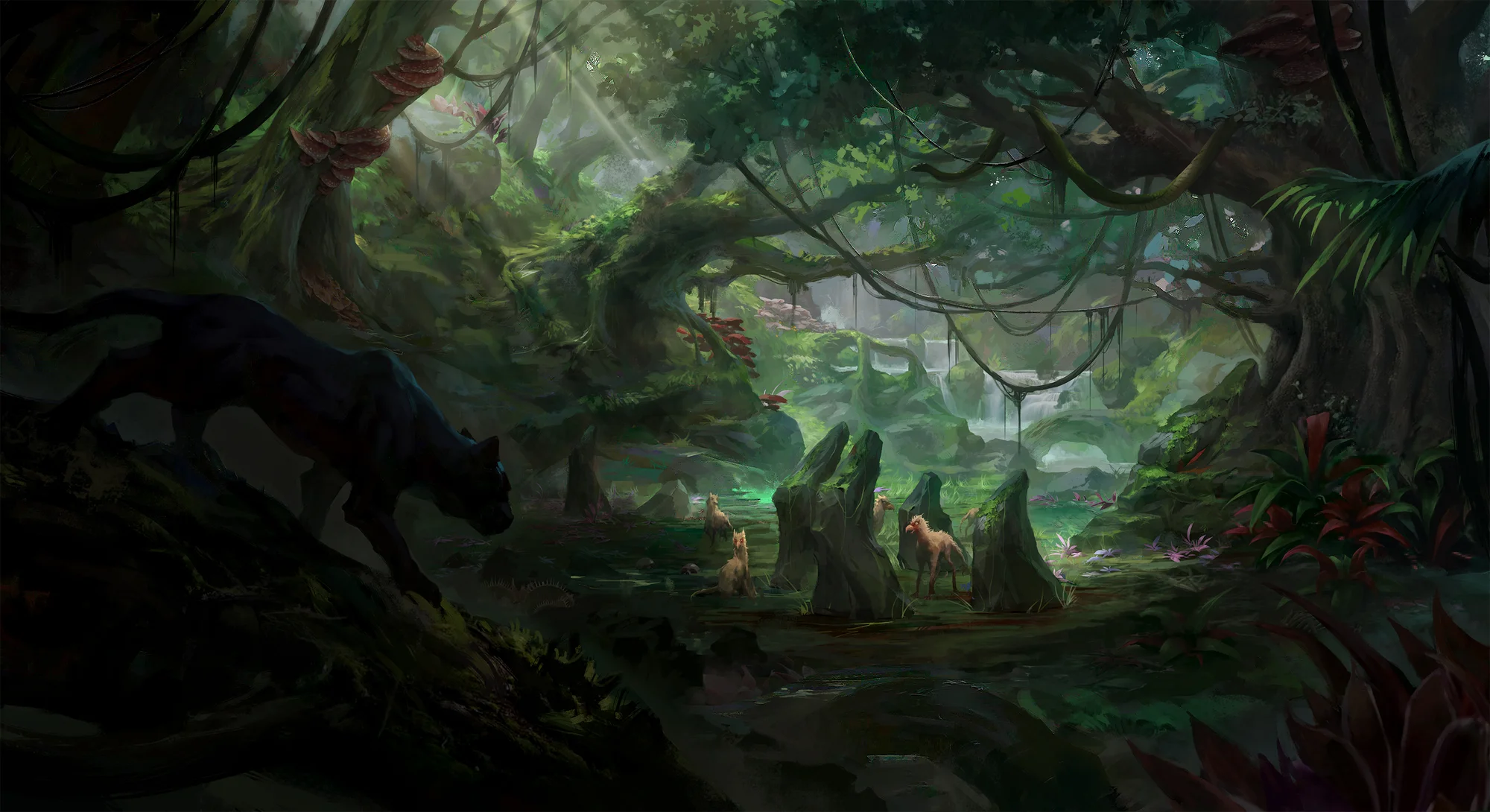

Savage Lands
An ancient primal wilderness, the Savage Lands is a jungle that sprawls far to the west of Rathe. This seemingly endless expanse of dense woodland is unrepresented by any map, due to its sheer size and the dangers that lie within. It remains untouched by the passage of time, as generations of humans try and fail to tame or settle any part of the vast jungle.
The first known explorers to survive the Savage Lands described a treacherous and unforgiving landscape, filled with hidden dangers and horrific beasts. With no landmarks to note their passage through the jungle, they found themselves lost within an endless mass of trees, with no way to navigate the jungle. Many members of that first party lost their lives within the wilderness, their corpses left to rot amongst the trees. However, those that survived returned with a wealth of information on the dangers and mysteries of the primordial jungle.
From massive predators to vicious scavengers, poisonous fungi to carnivorous plants, the Savage Lands are host to some of the most unique, treacherous and vile wildlife known to Rathe. Explorers have described being hunted by dark creatures that stalk their prey from the shadows; or watching their fellow adventurers writhe in agony as a deadly toxin spreads through their bloodstream; or trying in vain to hide from some massive, rampaging beast, trampling anything that crosses its path. The Savage Lands is a minefield of unknown dangers, waiting to claim the lives of the careless and the ill-prepared.
Call of Adventure
Despite the dangers, foolhardy adventurers gather from all over Rathe, attracted by the stories of successful hunts and famed explorers. A growing number of encampments have appeared on the outskirts of the jungle as more adventurers continue to arrive, risking their lives in hopes of achieving fame and fortune. While the Savage Lands attracts many prospective explorers, all eager to discover what lies hidden within its depths, few return unscathed to bring back useful information. One individual to lead a ‘successful’ expedition was Theodore Hamilton Scarborough. A researcher who sought to uncover the jungle’s secrets, Scarborough amassed a large team of mercenaries and explorers, of which five emerged from the Savage Lands alive. As one of those few survivors, Scarborough wrote at length about his experiences, detailing the fauna and flora the party encountered.
THE PRIMAL WAY
The jungle claims the weak | the feeble and slow
Those who cannot endure | their end feeds the wild
The wild claims the blood | the flesh and bone
Feasts upon the dead | and the dying, all
Where is the kindred | of the jungle deep
Whose heart still beats | somewhere beyond
Predator or prey | kill or be killed
In fear quake all | who at death’s feet lie.
– Carem Dunfirth (deceased) of the Scarborough Expedition.
Brutes
The Savage Lands is a place of brutality, and the Brutes are its fiercest creation. These predatory beings, driven by instinct and strength, are the living embodiment of the wild’s untamed fury. Brutes are shaped by the land’s unforgiving nature, able to claim any terrain as their own. They respect the land as a teacher, mastering its threats to turn survival into dominance. Their instincts are honed to a deadly edge, and their adaptability allows them to endure where others perish.
Scars and tattoos mark a Brute’s journey through the Savage Lands, each one a story of hard-won survival. A scar is painful learning; a tattoo is the triumph of mastery, a symbol of conquering a predator or rival. These marks define a Brute, their skin a tapestry of their resilience and lessons learned. This ability to evolve ensures their place at the apex of the food chain, no matter how fierce the competition.
Daily Life
Most Brutes live solitary lives, wandering the Savage Lands and carving their survival from its environment. However, tribes have been known to emerge, often born out of necessity or unique opportunities. These groups allow Brutes to pool resources, tackle larger prey, or defend against external threats.
Every aspect of a tribe’s existence remains rooted in survival. Hunters bring down massive prey, while others guard their kills from lone brutes and scavengers. Feasts follow successful hunts, blood rites honor their dead, and each member must prove their usefulness to the tribe. Those who fail are shunned, left to fend for themselves in the unforgiving wilds.
Despite their harsh lives, there is structure to Brute society. Feasts serve as moments of unity, where the tribe reflects on their victories. Rituals are often accompanied by chants that echo through the wilderness, reinforcing their bond with the land. Each Brute’s role is critical to the tribe’s success, ensuring no effort is wasted in their relentless quest to endure.
Tribal Hierarchy
Leadership among Brutes is earned, not given. The strongest member, the Gorelord, leads the tribe, their authority only as good as their last victory. To challenge a Gorelord is to risk everything. Battles for leadership are brutal and final, often reshaping the tribe’s dynamics. This constant struggle ensures that only the most capable lead, keeping the tribe strong and resilient. Retired hunters, revered for their wisdom and continued usefulness, take on the role of Shaman. They guide rituals and serve as living repositories of tribal knowledge. As the Gorelord and Shaman guide the tribe, all other members are expected to contribute in every way they can.
Lone Brutes
While tribes sometimes form, most Brutes remain solitary. These Brutes reject the structure of tribal life by choice. Too wild to obey a Gorelord, yet not wishing to become one themselves, they pursue their own purpose. Some believe that the constant distractions of tribal life weaken their wild strength, so are driven to master themselves in isolation. These wanderers may seek challenges greater than a tribe can offer, hungering for a test that will bring them closer to the land’s primal essence.
Some are outcasts: runts or individuals deemed too weak or small to survive within even a fledgling tribe. These runts, left to die in the wilderness, are often forced to adapt in unexpected ways. Their survival against all odds often transforms them into dangerous, unpredictable beings.
Whether outcast or wanderer, Lone Brutes often develop unique traits and tactics, shaped by their solitary existence. Without a tribe to rely on, they grow fiercely independent, surviving by sheer will and unrelenting ferocity. Yet, even in isolation, they carry the spirit of their kin, their scars and tattoos marking them as Brutes, forged in the brutality of nature.
Hecklers
Perhaps hecklers were once explorers or even settlers, lost within the jungles long ago. Left to fend in an unforgiving landscape, they left civilization behind to survive.
Hecklers are ruthless, feral and violent, attacking anything that crosses their path. They are nomadic, traveling in small groups, wearing lightweight leather armor to enable mobility. Groups of hecklers will ambush traveling parties, killing and stealing in rapid hit and run raids.
First Heckler Encounter
Scarborough and his expedition were camped when a group of feral humans ambushed them before dawn. This was the first recorded encounter with hecklers, whom Scarborough named for their style of attack.
“The hecklers rarely seek direct confrontation. Like birds, they flit in, snatch what they desire, and disappear just as quickly. Despite my best efforts, I have failed to encounter many, only catching glimpses.” – Scarborough.
Scarborough’s next encounter with a sentient jungle creature during the same expedition was a markedly different experience, as his notes record when his campsite was once again ambushed.
“A pack of hulking brutes charged out of the trees. They were giant in stature, far taller than my largest man, with thick hides and beady red eyes. They grabbed one of my mercenaries, Quenton, tore open his flesh with their bare hands, and scoffed his entrails in their ragged-toothed maws. Had they not been so distracted by their feast, I doubt the rest of us would have escaped with our lives.” – Scarborough.
BESTIARY OF SCARBOROUGH
Dangerous Fauna
Scarborough’s bestiary notes detail terrifying encounters. From great, scaled beasts with dripping fangs, or crystalline skin and serrated limbs, the creatures in the Savage Lands are lethal. Elite predators and monstrous beasts populate the jungle, striking down their prey with deadly accuracy and ravenous ferocity. While in the undergrowth beyond the apex killers, small scavengers lurk, waiting for the opportunity to pick apart discarded carcasses for scraps of muscle and marrow.
Ank’is
This crystalline creature does not bleed, it shatters. The teeth are harder than stone, with serrated edges and a needle-like tip to tear through flesh. Its limbs are long and thin, with sharp points which allow it to grip onto most surfaces and scale the difficult terrain of the Savage Lands.
Brawnhide
A giant furred beast with small, dark eyes. Their distinguishing feature is long, protruding canines, which are almost impossible to break, being both thick and sturdy. Long, dark gray fur, fading to an off-white at the tips, covers most of the body. While the brawnhide appears to have poor eyesight, it has a heightened sense of smell. There are multiple accounts of them tracking prey through the jungle by scent alone. The brawnhide also has a set of claws on their enormous feet. However, hindered by cumbersome feet and short legs, the claws appear to offer little protection.
Peluda
A large creature with a thick fur coat interspersed with sharp spikes. The peluda is capable of rapid speed because of its muscular legs. The weighty tail can sweep a would-be predator off its feet, leaving it vulnerable to the peluda’s deadly, hooked claws. While the tail appears to have a stinger, further tests have shown that the barb does not contain any form of toxin.
Rek’vas
A swift and deadly creature, the rek’vas hide has patterned scales that are highly toxic. A hood of brightly colored skin that flares from either side of its neck frames the massive head. Its large fangs and claws, which are retractable, are used to attack prey and tear through the tougher skin of creatures such as the brawnhide. Besides the toxin coating covering its scales, its venomous bite can inflict deadly poison into its prey.
Skera
One of the Savage Lands most skilled predators, skera are nocturnal, relying on the darkness to help mask their movements while stalking prey. Their two pairs of eyes likely aids its ability to hunt in the dark. They are large, muscular creatures with long, curved claws similar to talons. Their hide is covered in a mixture of fur and spikes, patterned with dark, irregular spots. They feature a barb at the end of their tail, which is also toxic.
Strix
A comparatively frail creature built for speed rather than strength. Strix travel in groups to ensure the safety of the herd. Their long legs allow them quickness, escape being their primary form of defense against jungle predators. Feathers cover most of the strix body, excluding their soft bellies, which are protected by a layer of tiny scales. The strix are carnivorous; they scavenge carcasses of prey left behind by larger predators. Their sharp, hooked beaks allow them to tear even the smallest remnants of flesh and muscle away from bones. An exceptionally acidic stomach allows them to digest small bone fragments, swallowed whole.
Botanical Compendium
Deadly Flora
Scarborough’s notes also speak of the effects of poisonous plants upon his unsuspecting party members, including a man who tried his hand at jungle cooking and one woman who merely touched a fungus with her hand. Scarborough relays their fates with horrifying detail: convulsing on the ground; foaming at the mouth; eyes rolling back into their skulls as blood seeps from every pore; screaming manic ramblings; vomiting up one’s own entrails. Not all the plants found within the Savage Lands have disastrous side-effects, and Scarborough mentions the existence of a handful of beneficial and restorative plant species. However, his surviving notes only detail one such plant.
Blacklace
A small fungus, characterized by its shiny, jet-black top, protecting the delicate white lace beneath. The lace structure is dangerous when consumed, causing fever, delirium and, eventually, death. When burned, the blacklace releases a smoke with hallucinogenic properties.
Bloodroot Moss
A seemingly delicate plant, with small, frail leaves, the delicate appearance hides its truly dangerous nature. Some of the local hecklers use bloodroot moss to make Bloodrot, a poisonous coating used on arrows. This species does not require soil to thrive. It spreads by latching onto living creatures, absorbing the nutrients and sugars within their blood. Adult plants produce an abundance of fine, airborne seeds, which are easily carried on the wind. Once they land in a creature’s fur or skin, thin roots sprout and work their way through the outer flesh in search of blood. The plant will then spread rapidly, coating the animal in a second skin of moss.
Druden
Wood from the druden is incredibly dense, making it one of the strongest trees in the Savage Lands. Its branches grow in unusual, twisted shapes, with broad leaves to soak up any available sunlight. The leaves, while bitter, are non-poisonous.
Haldor
A large, slow-growing tree with an incredibly thick trunk. The favored nesting ground of multiple species of birds, haldor trees can survive for hundreds of years because of a complex above-ground root system, which lifts further off the ground as the tree matures. The warren of roots also makes for an ideal shelter or habitat for ground-dwelling creatures.
Kindleweed
A plant known for its small, glowing red berries and thorny black leaves. While the lustrous berries may appear temptingly wholesome, the kindleweed is among some of the most poisonous plants in Rathe. Ingesting a single one of these tiny berries can kill an adult within an hour.
Pata
A vibrant red fungus named after the brave botanist whose life it took. Pata grows in large, flat, parallel formations, somewhat resembling a series of shelves. Its surface is covered in a thin layer of a deadly neurotoxin, which can cause seizures and death within minutes of skin contact.
Snapjaw
A carnivorous plant with sharp barbs, the trap of a snapjaw resembles a gaping mouth, lying open in wait until its prey triggers its taproot. Once a victim is enclosed, the snapjaw excretes a corrosive substance that excites rapid decay in the victim, allowing the plant to digest it.
Stoneberry Tree
With long, thin trunks and over-sized leaves, the stoneberry tree has a distinctive feature. Its berries are very large and hard as stone. Falling stoneberries can break bones, and have killed more than one unsuspecting adventurer.
Thieves’ Ladder
These vines start out small and thin, taking root upon the trunk of a large tree. The plant then climbs upward, setting down roots that over time work their way through the host bark. The thieves’ ladder roots then seek nutrients and water within the tree until it has literally drained its host of life. It then goes searching for fresher sources of nutrition.
Violet Lance
Found near the base of large trees, violet lance is a small, feathery plant that ranges from pale lilac to an intense violet color. It is perfectly harmless until digested, after which point it will work its way through the body, causing intense pain as the body shuts down. Its root system is equally toxic. The violet lance spreads through the release of tiny seed pods, which hang from a delicate flower. This flower allows the seed pods to be caught by the breeze, allowing them to travel great distances.
Visura
A short, dense bush with thick roots. The leaves of the Visura are poisonous to humans, but most creatures in the Savage Lands appear immune to the toxins. Its roots, however, are a potent energy source, and safe to eat. One must be absolutely certain to remove every trace of leaves before boiling the root, as the toxins will release into the water and contaminate the entire batch.
Wintergold
A rare flower with medicinal properties which is found in the depths of the Savage Lands. It grows clustered at the base of trees, with thin, blade-like leaves. The flowers, featuring pale blue petals and small orange centers, only bloom for two weeks in the middle of winter. The blooms are incredibly delicate, and whither shortly upon removal from the plant.