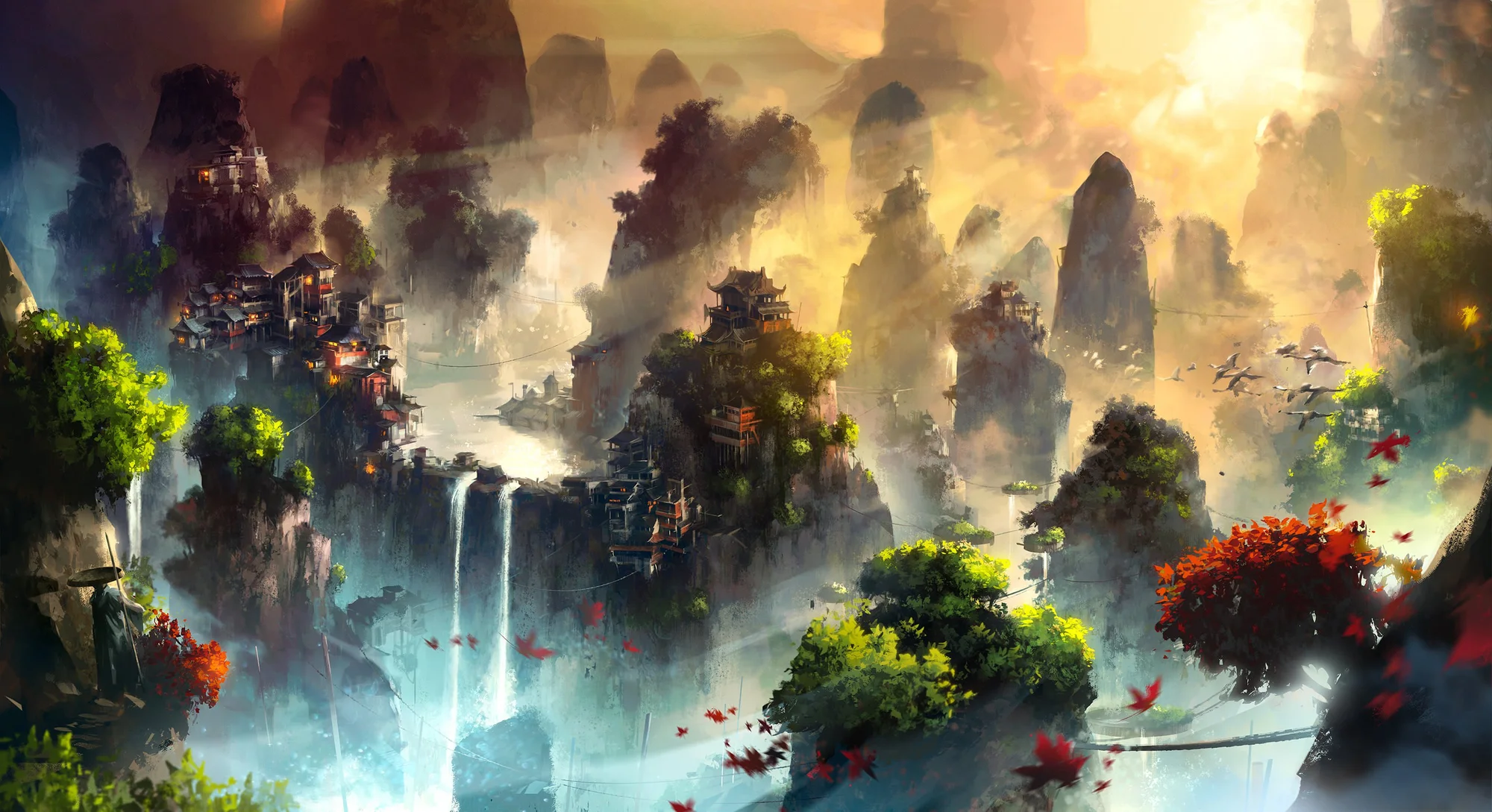

Misteria
Hidden behind an eternal veil of mist lies a close-knit tapestry of communities tucked into the jagged cliffs and mountain ranges of Misteria. These villages are shaped by the land itself, where the terrain is steep and unforgiving, and only those raised here can traverse its perilous paths without risk of falling to their death. Founded long ago, every village was born of one of the Prestigious Households of Misteria, ancient families that trace their lineage through the centuries. They have no ruler and no central authority to bind them, each governing their lands according to tradition.
Members of the old families live in clusters, their homes constructed on the highest levels of the village, vertical to the cliff faces. Individual houses hang between the cliffs, suspended from massive networks of rope. Larger communal buildings—inns, teahouses, and spaces for sparring—are carved directly into the stone or constructed in sturdy but lightweight bamboo and anchored to the rock-faces. Gardens, too, hang suspended from thick vines between the ravines, a burst of lush greenery against the backdrop of black granite and roiling white mists.
It takes enormous strength and agility to move between these buildings and places. From birth, individuals are taught how to balance on swinging rope bridges, scale cliffs, and jump across platforms. By the time they reach maturity, these skills are second nature.
Despite the physical demands of living in such rugged terrain, the people of Misteria cherish the tranquility of their mist-shrouded mountains, and the outside world holds little interest. Instead, they find satisfaction in introspection and self-discipline, training rigorously to strengthen their bodies and sharpen their minds. They value hard work and dedication, traits necessary to thrive in the landscape they call home.
Prestigious Households
SANJING
House Sanjing are the custodians of Mistcloak Gully, and masters of the Art of the Sparrow. They pioneered the cliff-face thoroughfares now used across Misteria, imagining delicate pathways that intertwine sky and stone. Their movements, like their designs, appear effortless, emphasizing harmony between body and environment. Master Jiro Henshu, their most renowned figure, refined their rites of passage, mapping and drafting such causeways that the Sanjing legacy endures in every rope and rung of Misterian traversal.
MIHARU
House Miharu creates some of the best armor in Misteria, flexible enough for hand-to-hand combat, yet tough enough to defend against attacks from a sharp weapon. The quality is so respected that House Miharu provides armor for the most prestigious armed forces in Misteria.
YIJUN
House Yijun prides itself on its mastery of silk weaving. Members create some of the most remarkable cloth and items of clothing imaginable. The fabric they fashion can resemble anything from the wavy, shimmering ripples of a stream, to the subtle sparkle of sunlight glinting through the mists. So adored are their creations, the people of Misteria scramble to be the first to purchase their outfits for festivals and celebrations.
ISHIGAKI
The villages surrounding Mistcloak Gully exist, in part, to the exceptional talent found within House Ishigaki. The work of stonemasons from this household is incomparable; their skill—especially when combined with designs from House Sanjing—has led to the most elaborate and celebrated buildings in Misteria, many carved into the most formidable peaks and bluffs in the land.
IKARU
The Ikaru Clan, also known as the House of Blossoms, was one of the great houses of Misteria that perished during the Night of the Dark Tide. Founded by Mistress Ikaru four hundred years prior, the Ikaru were adept gardeners who left their lands adorned with cascading hanging gardens and perfectly balanced terraces. The clan is but a memory, but their legacy continues in the fruitful cherry orchards and immaculate rows of tea bushes across Misteria.
Beneath the Veil
Misteria is deeply rooted in customs and rituals dating thousands of years, and successive generations learn the ways of their ancestors. From elaborate ceremonies and festivals, to their education in the Seven Arts, to the existence of groups such as the Aui’s Scales, the people of Misteria master the disciplines intrinsic to their traditions and the environment, including multiple practical arts and martial styles.
Rite of Passing
Once a year, when the veil between the living and spirit worlds is thinnest, the Rite of Passing occurs. Spirits are welcomed home and invited to join in a celebration.
At nightfall, Misterians don ornate ceremonial masks, obscuring their faces to become indistinguishable from the spirits. Lanterns are lit and released into the sky, drifting through the valleys and casting a glow over the dancers below. The celebration lasts until dawn, when the spirits return to the realm of the dead.
While larger villages hold grand festivals, the traditions of the Rite vary across Misteria. Small villages may conduct simple rituals, such as sweeping cemeteries. Others, wary of the night’s power, refuse to acknowledge it, fearing misfortune. There is no fixed date for the Rite and it is not controlled or mandated by any authority. Rather, it occurs naturally whenever the boundary between the two worlds dissolves beyond mortal influence.
Spirits
In Misteria, spirits weave their presence into the fabric of daily life. Their forms shift like water to match their temperament; some appear as fleeting mistforms in lantern light, others as whispers in the wind.
There are benevolent spirits, and some are revered as protectors of sacred groves. They may guide lost travelers, or watch over the shrines where Misterians place offerings of rice and incense in the memory of their ancestors. Other spirits, however, are tempests of mischief and malice, unsettling the harmony of a village with eerie laughter, or whispered deceits that lead the foolish astray. Trickster spirits, such as the cunning “gentua”, plunder the crops of unknowing farmers. Yet, in Misteria all spirits are accepted as they are: not foes to be vanquished, but echoes of the unseen world—reminders that the boundaries of reality are never truly fixed. Manifestations which are neither wholly good nor evil, they simply flow like the tides of chi through the land and its people.
Training Grounds and Dojos
Follow the sounds of laughter, playful jeers, and the occasional crash, and you will come upon a communal training ground at the heart of most villages. These purpose-built platforms, or buildings, are noisy and lively social places, where people of all ages come together to maintain their fitness.
Here, villagers gather for group combat practice, but also to build up the strength and agility required for living in the interconnected houses and gardens strung high on the cliffs. Keeping one’s balance is a vital survival skill the very young must learn, and then preserve, throughout their life. The space provides a safe place for parents to hone their children’s stamina. It also allows individuals to develop their own skills in the company of friends, or assist the elderly who may find everyday physical tasks increasingly difficult as they age.
In contrast to the lively communal grounds, however, the dojo is positioned in a private spot away from the noise to better facilitate formal lessons. Here, the master can focus on instructing dedicated students, whether that is drilling commonplace martial techniques, such as archery, and the quarterstaff, or honing unique methods known only to the tutor. Over time, diligent students may master secret techniques in hand-to-hand combat or swordplay, handed down by their grandmaster.
Teahouses
In Misteria, teahouses are sanctuaries of thought, decision, and focus. Behind the sliding doors, words are measured as carefully as the tea poured, for every great decision is made with a cup in hand. Stepping inside, one crosses a threshold between the physical and the spiritual, where the scent of rare leaves and the gentle hiss of boiling water awaits to cleanse the mind.
The ritual of drinking tea is sacred. Each brew, a careful alchemy of roots, flowers, and leaves, serves a purpose beyond refreshment. A sip of moonleaf tea stills a restless heart. Whereas a crimson petal infusion sharpens mental clarity, removing blindfolds from what is unseen. For those who seek otherworldly visions, a tincture of spiritbloom and peakroot can send one’s thoughts drifting beyond the waking world. Every village has its own blends, each believed to unlock something within. Some travelers journey weeks to partake in a specific tea, trusting its properties to provide guidance.
Gathered around low tables, shrouded in mist and lantern-light, communities meet in teahouses to share counsel. In these hushed spaces, elders weigh matters of land and lineage, warriors soothe the frictions of rivalry, and wanderers find the stillness to remember why they travel. Entering a teahouse is to surrender to the moment, allowing the tea to unravel burdens and weave clarity where there was doubt.
For the people of Misteria, the teahouse is where one finds balance, where past and future meld into the warmth of the present.
The Seven Arts
The Seven Arts encompass every occupation and role within Misteria. Education for every Misterian begins with a foundation in all seven, slowly reducing the number of subjects as the child chooses their path. The Seven Arts have been a part of Misterian culture for generations, curated from centuries of traditions and customs. Through the Seven Arts, ancient skills and practices have been preserved, so that they can be passed on for generations to come.
Signs
The Art of Signs is the mastery of language, poetry, and tradition. Those who follow this path preserve history, compose songs, and officiate ceremonies, ensuring the soul of Misteria endures. Calligraphy is revered as a sacred practice, each brushstroke carrying the weight of lineage and honor. Masters of the Signs serve as scribes, orators, and diplomats, weaving words like silk to maintain harmony within their communities.
Hand
The Art of the Hand is the way of martial discipline. Through rigorous training, students forge their bodies into weapons, mastering unarmed combat techniques such as powerful kicks and qi strikes. Armed training follows, with expertise in swords, staves, and bows. Practitioners cultivate balance, endurance, fast reflexes and unwavering spirit, standing as protectors of Misteria’s people and traditions.
Sparrow
The Art of the Sparrow is the embodiment of fluid motion. Students learn to navigate the Mistcloak Ranges with ease, flitting like birds across rooftops, bridges, and cliffs. Agility and balance are paramount. Masters of this Art tread with precision, slipping through gaps in the world with effortless grace where others would fall to their death.
Serpent
The Art of the Serpent teaches practitioners how to blend seamlessly with their surroundings, so they exist within the world without disturbing its rhythm. A master of the Serpent moves without trace, their footfalls swallowed by the silence. Their presence is so subtle they are as natural as the mist.
Nature
The Art of Nature is the underlying harmonious relationship between life and land. Practitioners of this Art cultivate the hanging gardens of Misteria, tending the rare herbs and sacred groves. Their knowledge of plants extends beyond providing sustenance for the community; each leaf, root, and petal holds a secret they have learned to unlock, from salves that heal wounds to brews that calm the soul.
Stone
The Art of the Stone is the foundation of civilization. Masons, smiths, and artisans craft structures that withstand time, shaping metal and rock into homes, tools, and weapons. Those who etched their legacy into steel and stone fuel Misteria’s forges and quarries with their labor, ensuring their people’s survival with each hammer strike.
Willow
The Art of the Willow is the essence of beauty and function. Tailors and artisans craft the apparel that define Misterian culture, from the humblest farmer’s smock to the most elaborate ceremonial robes. With deft hands, they weave silk thread into attire that honors tradition, while masks of painted wood whisper the tales of ancestors. Every piece, no matter how simple, carries an elegance that reflects the harmony of Misteria. The graceful Willow bends, but it does not break. Its beauty endures, as does the spirit of its people.
The Keepers of the Seven Arts
A revered council of instructors and scholars, the Keepers of the Seven Arts are the sanctioned protectors of Misteria’s traditions. Each Keeper is a grandmaster of their discipline, entrusted with preserving and refining their Art. They ensure that the knowledge and traditions of Misteria endure through disciplined study and instruction.
Occasionally, a Keeper will take on an apprentice, a devoted student who lives and trains under their guidance, inheriting their knowledge and the time-bound duty of passing it on. Through this mentorship, the Keepers ensure that the techniques and wisdom of their forebears remain unbroken to shape each new generation.
The Grandmasters Guild
The Grandmasters Guild is not a formal organization, but a collection of individuals who have attained unparalleled mastery in their respective Art. Though enigmatic, their legacy is undeniable, their work helping to refine the Seven Arts and uplift villages across Misteria.
Though these Grandmasters often work closely with the Keepers, either teaching for them or advising on matters of instruction, individual practices and philosophies sometimes challenge upheld traditions. These clashes are not always amicable, yet seeds prosper best in freshly turned soil, the Secret Arts often benefitting from the rifts between Grandmaster and Keeper.
Mistcloak Gully
Mistcloak Gully is a sprawling region of cliffs and waterfalls encircling a lake, revered among the people of Misteria for its beauty and resilience in the face of adversity. Once home to the Ikaru Clan who perished during The Night of the Dark Tide, it is now the custodial seat of House Sanjing.
Here, nature prevails. The fine spray produced by the waterfalls, and the filtered light from above, provides just the right conditions for the native flora to flourish.
Misterians have adapted to life within the gully, suspending their buildings from vines and ropes atop bamboo poles or carving them into the mountainside itself. And at the foot of flooded ravines, some buildings float on top of the water, only partially anchored at the sides in order to rise and fall with the changing levels.
Mugenshi Gorge
Carved by wind and time, Mugenshi Gorge is a labyrinth of sheer cliffs and hidden stairways. Suspended dwellings sway gently in the winds, their lacquered beams bound by thick rope clinging to the rock face. Footpaths etched into the stone itself, worn smooth by generations of footfalls, twist between waterfalls and cavernous hollows, leading to training halls where the air itself is a teacher.
Deep within the gorge lies the hidden village of the Mugenshi Clan. Their ancestors vanished into these crags and gullies long ago, and in isolation, they have become one with the wind. To the Mugenshi, combat is not bound by steel, but by movement, swift and fluid. Masters of the lost Art of Wind, they have learned to harness the unseen currents, striking as harsh as a gale and moving with such speed and agility that their presence is felt long after the dust settles.
Yet among the peace and tradition, a lingering affliction gnaws at the clan’s bloodline, weakening body and spirit. Some accept this as their fate, but others stare beyond the mist-shrouded cliffs, wondering whether the price of seclusion is one they should continue to pay.